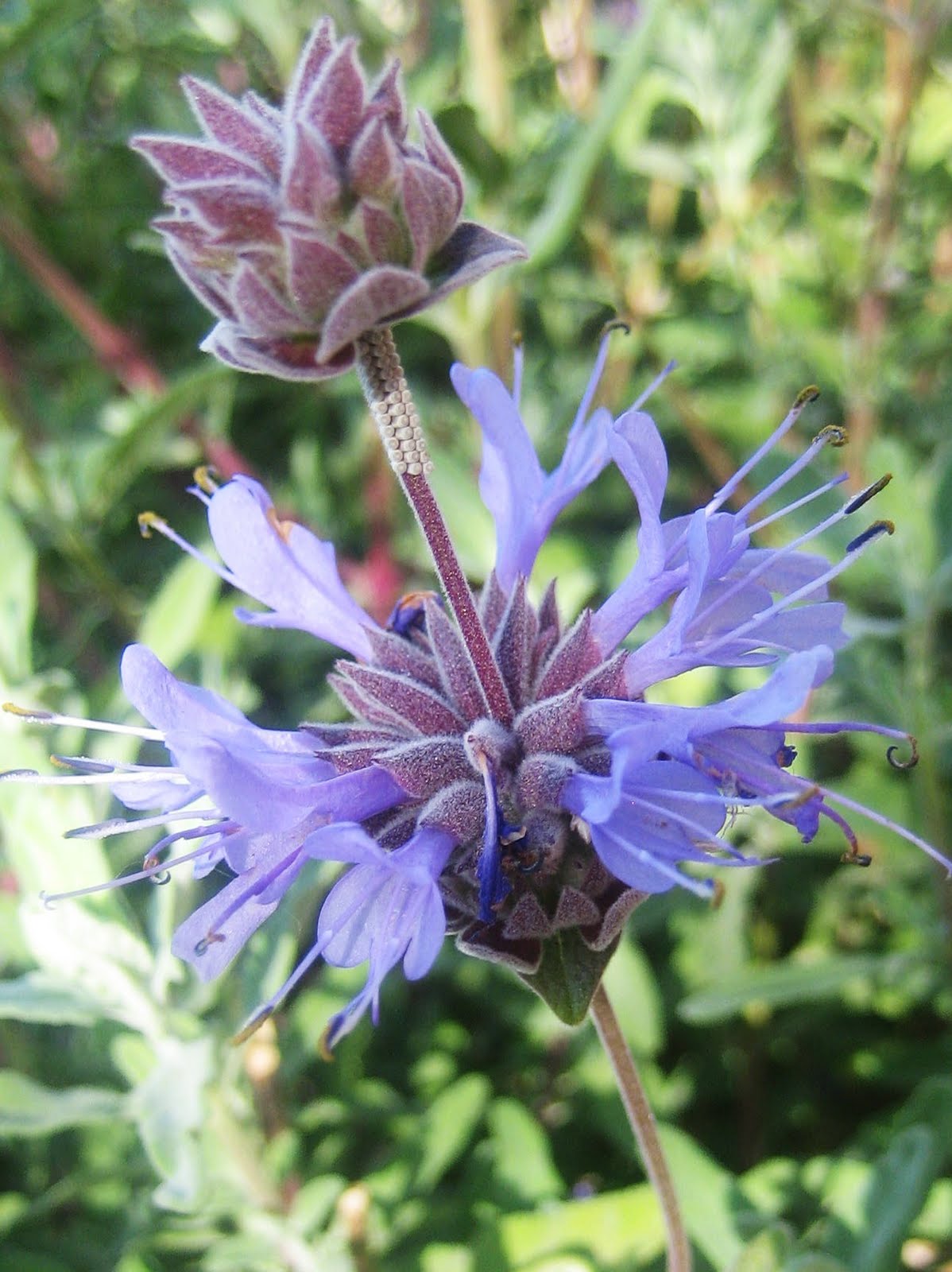
I recently joined Little Man's school for a field trip to one of Arizona's dessert botanical gardens, and along with a few cactus, I had some eye opening experiences. My son asked me if I could survive in the dessert just by living off of dessert plants. Did his mom have the knowledge to pass the test? Would I eat this? Would you? This is purple sage. One of the first references I looked at for
Edible Flowers was on the Colorado State University Extension office site. I couldn't find this sage there. However according to the
Cooking with Sage - Herb Expert (UK) it is safe.

Would you eat this? Okay, technically it isn't looking much like a flower, but it is called Agave. Agave Americana to you. Each agave plant will produce several pounds of edible flowers during its final season. I've used agave nectar in cooking and I've been told it makes tequila...though I've never tasted the stuff.

This is our state flower. Is it edible? I personally don't want to be committing a crime even going near a saguaro. As I'm not sure if it is punishable by law to swipe the flowers, however I read that in Tucson AZ, a lady named Cathy Lambert reportedly makes her own Desert Decadence Saguaro Blossom Cactus Tea from saguaro fruit she harvests on her own property. She adds other ingredients, such as rose hips and strawberries, and markets the product all over the country. One such market is PaulsPantry.com, located in Scottsdale, AZ. I found this quite noteworthy from:
The Edible Saguaro Cactus Notecook
Some of the girls in my sons class started ripping these flowers off bushes as we walked and sucking on the pointed end. One of them said, "Mmmm honeysuckle." Okay...as a mom, I almost freaked. As a dessert explorer and foodie, I was slightly intrigued, as you can imagine my inner turmoil. Come to find out...many of the species of honeysuckle have sweetly-scented, bell-shaped flowers that produce a sweet, edible nectar. Breaking of the Honeysuckle's stem will release this powerful sweet odor. The fruit is a red, blue or black berry containing several seeds; in most species the berries are mildly poisonous, but a few (notably Lonicera caerulea) have edible berries. So, cool to suck on the flowers...but not cool to eat the fruit or seeds. Most likely best to only eat ones you are sure haven't been treated with heavy pesticides too. Where was I when they where handing out the info on sucking on flowers? Probably sharpening my knives. Dang it.

As a general rule, I'm not eating cactus flowers. Though they are so gorgeous.

Here's another thing. My boys would never collect seed pods and make bouquets. It wouldn't happen. It was very diverting to hang out with girls for a change.

This my friends is the first and only lilac bush I have ever seen with flowers on it in Arizona. It just doesn't happen here due to the horrible heat. I've looked. Lilacs are edible. I think they are gorgeous candied on a cake. But...good luck finding any that don't look like this...in Arizona anyway.

Okay...what about this bulgy thing here? Did you know it is against the law to collect these on national forest land here in my happy state? However, this fruit makes excellent jams and jellies...if you can get all the spines off. Prickly pear. Ooo la la.

What pray tell, started me thinking about posting something on flowers you can eat? It was this article called:
Edible Flowers Eight easy-to-grow edible flowersBy: Teresa O’ConnorTeresa is co-author of the book:
Grocery Gardening (I got the book and adore it!! Shameless plug but I think everyone should get a copy. It's highly informative and full of amazing recipes.)
Teresa wrote:
"Wake up your taste buds with these flavorful flowers that taste as good as they look.
Borage
This annual grows 2 to 4 feet tall with purplish blue, star-shaped flowers that “make the mind glad,” according to renowned 16th-century herbalist John Gerarde. Sow seeds in a sunny spot in spring after last frost, or earlier in warm climates. Borage (Borago officinalis) tolerates most soil types and usually reseeds itself. Transplanting isn’t recommended because the plant has a taproot that’s difficult to unearth.
Borage adds a cucumber taste to salads, dips, and cold soups. Freeze flowers in ice cubes to float in decorative drinks. In large amounts, borage may have a diuretic effect.
Calendula
Also known as pot marigold, this annual was a favorite in medieval cooking pots. Calendula (Calendula officinalis) grows up to 20 inches tall, with attractive pale yellow to deep orange flowers. Sow seeds in a sunny spot in well-drained soil. Provide afternoon shade in hot temperatures. In colder climates, start indoors. This easy-to-grow plant self-sows freely.
Sometimes called “poor man’s saffron,” calendula has a slightly bitter taste. Petals add color to scrambled eggs, cheeses, poultry, and rice. Try chopped leaves and petals in soups, salads, and stews. Use caution if you have allergies to ragweed, asters, and other members of the Compositae family.
Chamomile
This annual has tiny daisy-like flowers immortalized in “The Tale of Peter Rabbit” when Mrs. Rabbit brewed a calming tea for her son Peter. Easily grown from seeds sown in spring, chamomile (Matricaria recutita) grows 1 to 2 feet tall in full sun. It prefers neutral to slightly acidic soil with good drainage. Chamomile reseeds easily, and can be invasive in some regions. Check with your local nursery or cooperative extension service to see if it’s invasive in your climate.
Chamomile’s sweet apple flavor and fragrance make a delicious tea. Steep 2 to 4 teaspoons of fresh flowers with a cup of boiled water for three minutes. Strain and serve. Use caution if you have allergies to the Compositae family.
Chives
This perennial (Allium schoenoprasum, Zones 3 to 11) grows 12 to 24 inches tall, with pink and lavender flowers that have flavored meals for centuries. It prefers full sun and moist, well-drained soil that’s high in organic matter. Planting rooted clumps is the easiest way to propagate chives. Seeds germinate slowly and require darkness, constant moisture, and temperatures of 60°F to 70°F. Divide plants every few years. Chives also grow well in sunny windows.
Break apart chive florets to add mild onion flavor to dinner rolls, casseroles, eggs, potatoes, and herb butters.
Lavender
Queen Elizabeth I reportedly sipped lavender blossoms in tea. This perennial requires dry, somewhat infertile soil with good drainage. It grows best in neutral or slightly alkaline soil in full sun.
Not all lavenders have the same culinary qualities. The most popular are Lavandula angustifolia and Lavandula x intermedia ‘Provence’ (both Zones 5 to 8). Lavender’s floral taste combines well with rosemary and thyme in chicken and lamb marinades. Add a teaspoon to sugar cookie and cake recipes. A little lavender goes a long way; too much tastes soapy.
Nasturtium
This annual has cheerful cuplike flowers that Thomas Jefferson used to spice salads at Monticello. Available in diverse cultivars, including climbing and bushy types, nasturtium (Tropaeolum majus) comes in bright colors such as orange, pink, and yellow. Sow seeds in spring in colder climates, or earlier in warmer zones. Nasturtium prefers light, sandy soils in full sun, with partial shade in hot temperatures. It flowers best in less fertile soils.
Flowers and leaves add peppery taste to salads, herb vinegars, sandwiches, and even pizzas. Immature pods can be pickled and used as capers.
Rose
Eating roses (Rosa spp.) dates back to the ancient Romans. Roses grow best in rich, well-drained soil with full sun and good air circulation. These plants prefer regular pruning, watering, and fertilizing. The older species, such as Rosa rugosa and Rosa gallica, are considered the best for taste.
Petals add a floral flavor to jellies, honey, vinegars, and salads. For rose sugar, mince one part petals with two parts sugar and leave covered for a month. Strain and use for cookies, cakes, and sweet breads. Rose hips make a delicious tea high in vitamin C.
Sweet violet, Johnny-jump-up, pansy
These three violas are old-fashioned culinary favorites that bloom best in cool weather. They all prefer rich, moist, well-drained soil. In hot climates, plant them in partial shade. Sweet violets (Viola odorata) are perennials with aromatic purple or white flowers. Typically hardy to Zone 5, violets are propagated by dividing clumps. Johnny-jump-ups (Viola tricolor) and pansies (Viola x wittrockiana) are annuals that are easy to find as transplants in garden centers.
These pretty flowers add sweet, perfumed, or wintergreen flavor to salads, fruits, and vegetables. Float flowers in punch, or candy the petals for elegant cakes and cookies. You don’t need to remove their pistils and stamens, however Johnny-jump-ups have saponins, which can be toxic in large amounts.
Many Thanks to Teresa O’Connor for permission to use this article. Teresa is a garden writer in Boise, Idaho. She is a master gardener in California, and Idaho. Her website is: http://www.seasonalwisdom.com/ "
There you go. Use some edible flowers in your cooking. I may just have to start you'all off on the right foot. Vanilla Lavender
Tapioca for starters.

 We went up to the sweet beautiful mountain breezes of Northern Arizona last week to get away from the crazy world and visit hometown USA. I saw (and smelled) my first small town rodeo. Up at our cabin, my sons where all about the edible plants. "Mom can eat this? What is that? Can it be eaten? How do you know you can eat it?" My favorite was this Little Man with some local foliage...
 His exact words, " Would you like a spot of tea?" Then they started bringing me flowers. It was heavenly to be showered with blooms from little hands trying to show their adoration. It's what every mother lives for...well that.. and slobbery oatmeal garnished kissed and stepping on Hot Wheels in the bathtub. I'm convinced I will miss those moments most of all when they grow up and leave me. Sniff, sniff.
 We do have about four hundred juniper trees on our land. It was fun to explain the culinary use of a berry on a tree.